



The routine work behind every client
Marketing agencies repeat the same work for every client: pulling numbers from Google Analytics and Klaviyo, drafting emails, building monthly reports, and chasing approvals. Cobar is a web app I built at Wallaroo Media to help with that work.
From a request to a reviewed draft
Cobar sends each request to a specialized AI agent for SEO, email, ads, content, or analytics. The agent uses the client’s data and brand voice to produce a finished draft. A person reviews and approves it before it goes out.
Account managers and specialists use Cobar day to day. Clients see their results through a client portal.
What I designed and built
Since February 2026, I’ve designed and built Cobar across product direction, the visual design system, the React interface, and the Python backend with a Postgres database. I built the setup that lets one agency manage many client accounts, and an AI layer that switches between model providers if one fails.
I also led a team of engineers and user testers who helped add features and fixes under my direction.
Every number is a claim
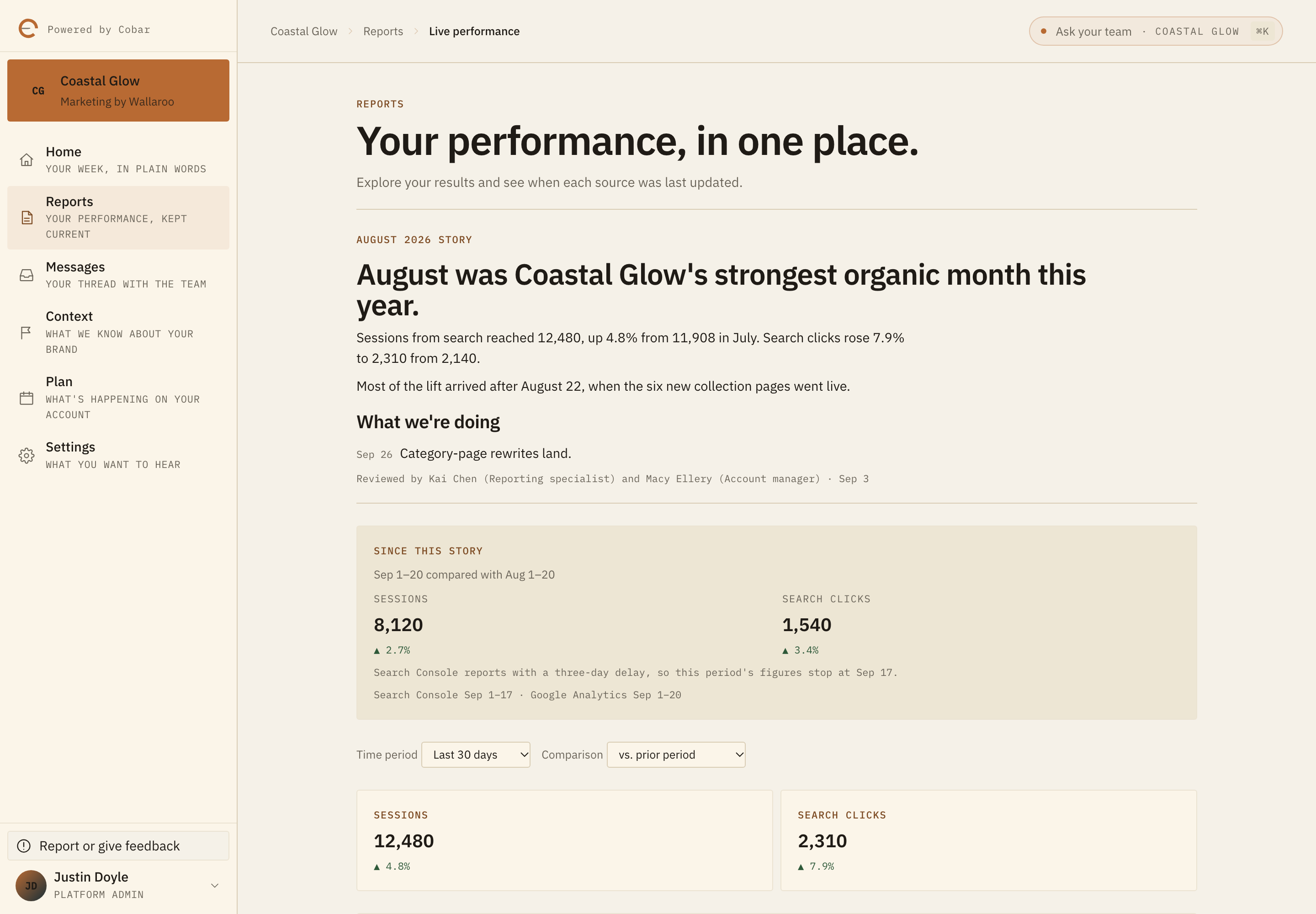
When I audited the agents, the data was correct when it was fetched. Errors crept in afterward, in totals, comparisons, and labels. A missing value became zero. A “vs. last month” comparison included the current month. A date label implied the data was newer than it was.
I made three rules the code enforces:
- Missing data is marked as missing, never shown as zero.
- Comparisons use the true previous period.
- Every “as of” label gives the date of the oldest data on the screen.
Search Console reports with a three-day delay, so this period’s figures stop at Sep 17.
Where it stands
Cobar is in daily use at Wallaroo Media. Paid early access for outside businesses is planned for December 2026.